

The day begins in a way that feels familiar in almost any organisation. Phones ring, emails come in, chat messages pop up, and customers ask practical questions about opening hours, invoices, orders, appointments, or technical issues. Teams generally know the answers, but a significant share of their time can still be taken up by routing calls, repeating standard information, taking notes, and updating systems. At the same time, customers increasingly expect fast, consistent service, anytime and anywhere.
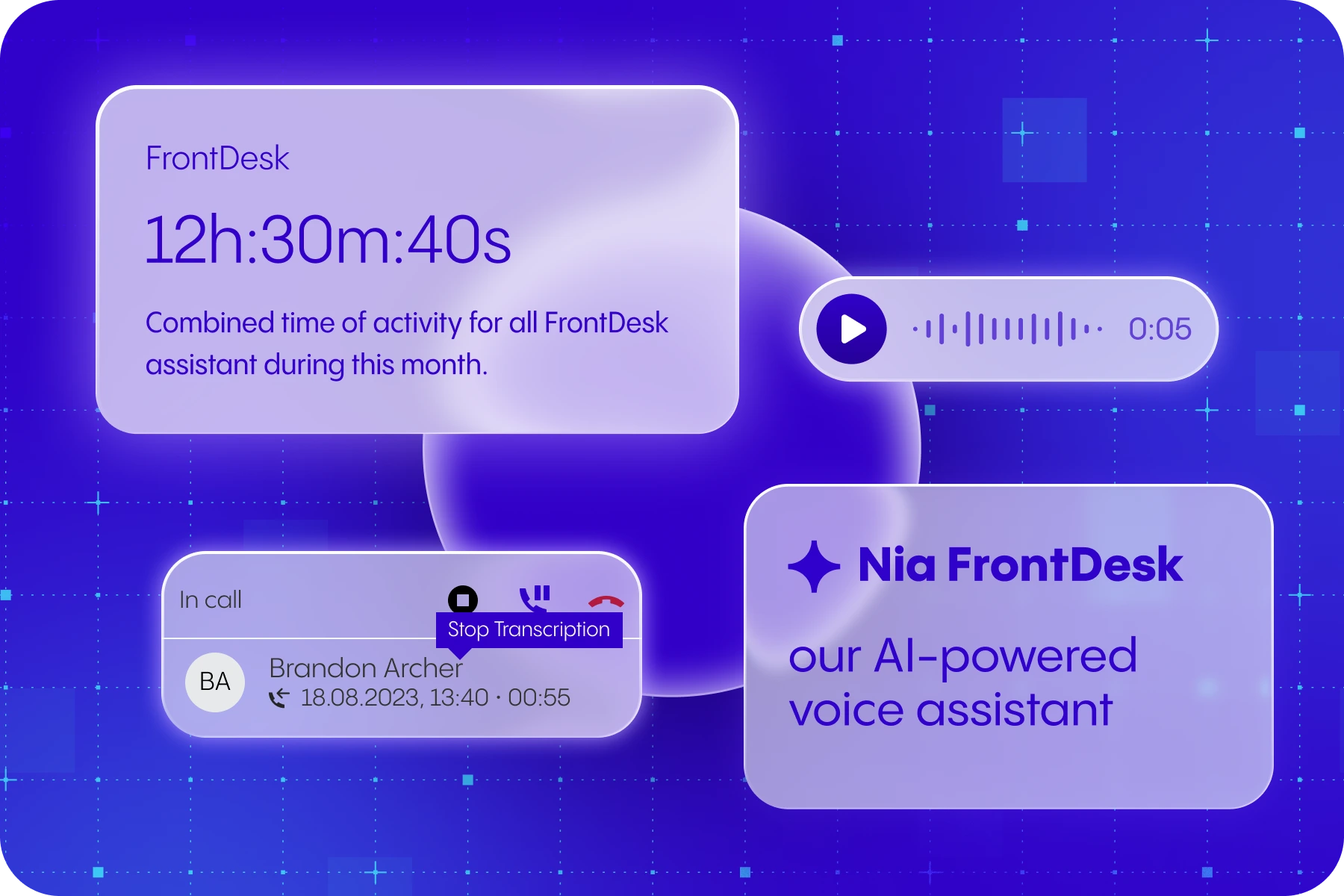
Now picture the same day but with NFON’s AI solutions in action. The main number can be answered by Nia FrontDesk, the AI voice assistant that greets callers professionally, understands why they are calling, and either responds to simple questions or routes the caller directly to the right person or department. Routine requests can be handled automatically. In the background, AI supports teams with notes, summaries, and follow-ups, helping them spend less time on manual administration and more time on conversations that require human attention. In practice, this can contribute to quicker, more consistent responses for customers and a more structured working day for teams.
Artificial intelligence becomes a strategic enabler for improving how people communicate and work. The focus remains outcomes-led: automating workflows and routine tasks, enhancing customer experiences, and supporting teams across the business with intelligent, scalable technology. That value is designed to work across stakeholder perspectives, business leaders looking for efficient, cost-effective improvements, IT teams prioritising secure and compliant solutions, and frontline teams who need tools that function reliably in day-to-day operations. Alongside the capabilities, the foundations matter as much as the features: transparent pricing, full GDPR and EU AI Act compliance, and native European hosting so organisations can adopt AI with confidence.
Adoption has increased significantly in Europe over recent years, and many organisations report business growth supported by generative AI. The point is not that AI is “coming.” It is already influencing expectations. Customers are learning to expect instant answers, clear self-service options, and smooth handover to human support when needed. Businesses are recognising that speed and consistency across channels are becoming baseline expectations rather than differentiators.
AI adoption in Western Europe has surged by nearly 92% over the last three years
AI adoption across EU enterprises rose by 5.4%, making AI one of the fastest-growing enterprise technologies.
63% of organizations have experienced business growth as a result of GenAI solutions
This is where a familiar tension appears: two realities inside one organisation. From the outside, the organisation appears well equipped: there is a main line, digital channels, email and chat, and support teams handling cases. Customers see one company and one promise. Inside, the same journey runs across cloud telephony, contact center software, CRM, ticketing tools, and internal knowledge bases. Each team may see a piece of the puzzle, but rarely the complete picture.
For customers, expectations remain straightforward. Whether they call about a contract, write about an invoice, chat about an order, or follow up on a service incident, they want a fast, clear answer. They generally assume the person they speak to knows who they are and what has happened before. They do not care which system holds information or which department owns which step. When they are transferred, kept waiting, or asked to repeat their story, the organisation’s internal complexity becomes visible.
Inside the organisation, that complexity often creates a chain of manual work behind every “simple” request. Calls are answered, interpreted, and routed. Emails are read, categorised, copied into tickets, and answered with information sourced from another system. Chats require switching between screens to find the right details. Afterwards, notes are written and fields are updated. None of these steps are inherently complex, but at scale—hundreds or thousands of interactions per day—they can contribute to operational load, slower service, growing queues, and increased pressure on teams.
That load is not only operational; it also affects how people experience their work. Employees want to solve complex issues and apply their skills, but much of their time can be spent on repetitive questions, manual lookups, and basic administration. When volumes spike, organisations may be pushed into reactive mode, focusing on keeping up rather than improving the experience.
Leaders often see the same pattern reflected in performance metrics. Routine enquiries consume significant staff time. Handling times remain high even for simple topics. Hiring additional staff can help temporarily but increases costs. Many organisations look for ways to handle more interactions while improving consistency across channels and keeping operational costs under control.
IT and compliance teams view the situation through a different lens. There is clear potential for automation and AI to support standard steps, summarise conversations, and route interactions more intelligently. At the same time, they operate in a European regulatory environment where GDPR, the EU AI Act, and industry-specific rules are non-negotiable. Introducing poorly governed or non-European AI tools into sensitive communication flows is not an option.
This creates a common dilemma. The need for AI is evident, but the wrong approach can feel risky: too complex to integrate, unclear from a compliance perspective, or adding layers rather than reducing them. As a result, some organisations experiment in isolated areas while core communication flows remain manual and fragmented.
NFON’s approach is to introduce one consistent layer of intelligence across the touchpoints where customers and employees interact, rather than adding isolated tools. The challenges do not stem from a single channel. They appear wherever interactions take place: on the phone, in contact center queues, on digital channels, and inside the tools teams use every day. The goal is to better align what customers expect—fast, consistent, personalised service—with what teams can realistically deliver inside complex organisations.
In cloud telephony, this intelligence supports everyday calls with transcription, summarisation, and automated capture of action points. Information from conversations no longer depends solely on memory or handwritten notes. It becomes structured, searchable, and accessible to those who need it.
At the main line, Nia FrontDesk functions as an AI voice assistant that greets callers professionally, understands why they are calling, answers standard questions, and routes them to the appropriate person or team. For callers, this can feel like reaching the right place more quickly. For organisations, it helps reduce missed calls, incorrect transfers, and interruptions caused by basic enquiries.
Across digital channels, NFON AI Bots support routine interactions by handling common questions, collecting information, and completing even complex processes using intelligent voicebots, chatbots, and phonebots that are available around the clock and support multiple languages. This helps reduce pressure on live agents while giving customers faster access to information. When human support is needed, context can be captured to support a smoother handover.
In the contact center, NFON Contact Center AI brings information from previous interactions and channels together, so agents have clearer context when responding. Routine enquiries can be supported by AI-driven automation in the background, while human agents focus on more complex cases that require judgement and empathy.
Across platforms, Nia, the NFON Intelligent Assistant, supports customers, partners, and employees in daily work. Embedded where questions arise, Nia answers questions, guides workflows, and automates recurring tasks, helping scattered knowledge and processes become more accessible.
All these capabilities share the same foundations. European trust and compliance combine with modern technology. With native European hosting, full GDPR and EU AI Act compliance and transparent pricing, organisations that cannot compromise on data protection can still adopt AI. Because activation is step by step, teams can automate selected parts of the journey, demonstrate value, and then scale across channels and teams without unnecessary complexity.
In essence, NFON’s AI capabilities act as an intelligent layer across an existing communication setup. Interactions continue to arrive from every direction, but information is handled more consistently. Conversations are captured, context travels with the customer, and teams can spend less time on repetitive work and more time on what matters.